Date: Wed, 23 Sep 2026 10:47:49 -0400
I can't really comment on your base pair stability or the project goals,
but for the "long bonds" make sure that you have loaded the files using the
proper format selection. In VMD, if you are loading ascii files, you
probably want to first load the parm7 file, and then for the rst7
coordinates you will load using the format amber7 restart. Even better is
to use netcdf files if possible, but if not make sure to choose the proper
format. likewise when you load a trajectory, make sure to load "amber
coordinates with periodic box" for a periodic system.
On Wed, Sep 23, 2026 at 10:39 AM Surabhi Singh 24933024 <
surabhi_s.bt.iitr.ac.in> wrote:
> EXTERNAL EMAIL - This email was sent by a person from outside your
> organization. Exercise caution when clicking links, opening attachments or
> taking further action, before validating its authenticity.
> Dear Eugene and Carlos,
>
> Thank you for your suggestions.
> I understand your point about short DNA duplexes partially unwinding
> during MD simulations. At present, I am applying restraints only during the
> initial minimization and equilibration phases. I will definitely try
> applying an appropriate restraint/umbrella potential between the terminal
> base pairs to reduce the effect of end fraying and mimic the behavior of a
> longer DNA duplex.
>
> However, there is another issue that I am still trying to understand. When
> I analyze the DNA using 3DNA, I sometimes find that the base pairs are not
> formed between the expected complementary bases. In some cases, a base
> appears to pair with a neighboring base on the opposite strand instead.
> Interestingly, this is occurring in the central region of the DNA and not
> near the terminal base pairs.
> I am therefore not sure whether this behavior is simply a consequence of
> the DNA structure changing during the MD simulation, or whether there is an
> issue with the initial structure/topology.
>
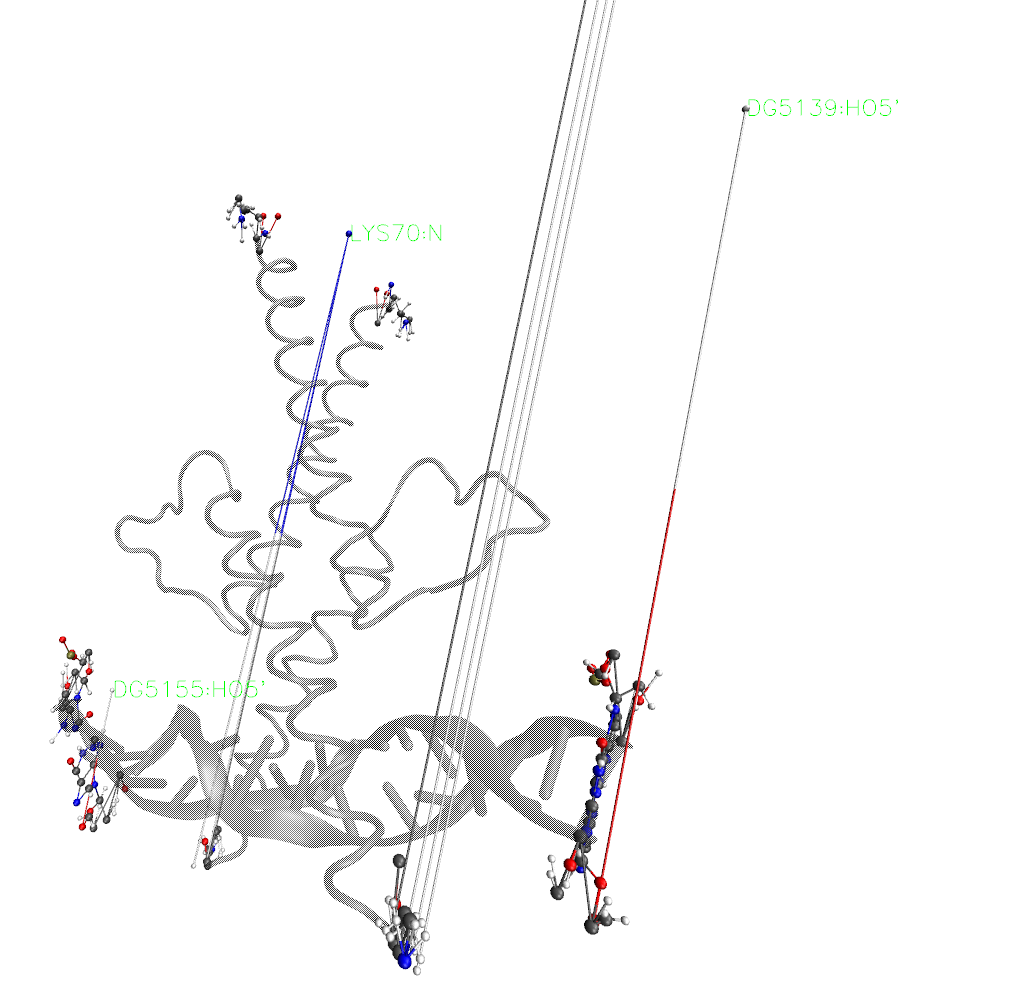
> There is also another observation from the initial tleap-generated system
> that I would like to clarify. In the topology/coordinate visualization, I
> see what appear to be very long bonds connecting terminal residues of the
> protein and DNA (LYS_70.N, DG5_139. HO5'... I have attached a figure,
> where the terminal residues are shown in CPK representation). However, when
> I inspect the coordinates in the PDB file generated by tleap, the
> coordinates themselves appear normal, and I do not see an obvious
> structural problem.
>
> I have attached the relevant files for reference:
>
> - the PDB file generated by tleap,
> - the corresponding PRMTOP file, and
> - the INPCRD file,
> - along with the figure showing the apparent long bonds.
>
>
> Could you please help me understand:
>
> 1. What could cause 3DNA to identify non-complementary or shifted base
> pairing in the central region of the DNA?
> 2. Could this be related to the way the DNA topology/connectivity is being
> generated by tleap, or is it more likely to arise from structural changes
> during MD?
> 3. What could cause the apparent long bonds between terminal residues in
> the tleap-generated system when the coordinates in the PDB appear normal?
> 4. Is there a particular way you would recommend checking the
> PRMTOP/INPCRD connectivity to determine whether these are actual bonds in
> the topology or simply a visualization artifact?
>
> I would really appreciate any guidance on how to distinguish whether the
> problem originates from the initial structure/parameterization or develops
> during the simulation.
>
> Thank you again for your help.
>
> Best regards,
> Surabhi Singh
> Ph.D. Computational Biology
> Biosciences and Bioengineering
> IIT Roorkee
> [image: image.png]
>
> On Tue, Sep 22, 2026 at 6:49 PM Eugene Radchenko <genie.qsar.chem.msu.ru>
> wrote:
>
>> Dear Surabhi,
>>
>> Short DNA duplexes often tend to partially unwind in MD simulations
>> (perhaps depending on specific force fields).
>>
>> One possible solution is to introduce some constraints (e.g. umbrella
>> potential) between end bases in order to simulate the effect of longer
>> strands.
>>
>> We did something like that here https://doi.org/10.3390/ijms26031270
>> <https://protect.checkpoint.com/v2/r01/___https://doi.org/10.3390/ijms26031270___.YzJ1OnN0b255YnJvb2s6YzpnOmI0NDViYzg4ZmE3M2JlZGJlMmVmMGI2NmFkYTc3NWQ4Ojc6OGVjZTo0OWU0OGM5OTk2N2RhMzdiNjJlZWViMzU1NjhjMDY3Y2E2YWEzY2IxZmJlNTk3ZTYxZmZiMjQwOWNmMWI2NDdiOmg6VDpG>
>>
>> Best regards
>> Eugene Radchenko
>>
>> On 22.09.2026 11:43, Surabhi Singh 24933024 via AMBER wrote:
>> > Hi Carlos,
>> >
>> > Thanks a lot for the suggestions.
>> > I followed your recommendation and checked the system in VMD by loading
>> the
>> > leap-generated topology and coordinate files, rather than relying only
>> on
>> > the PDB visualization.
>> > Interestingly, I observed that the N-terminal regions of the two protein
>> > chains appear to be extended in the structure generated by tleap. I also
>> > checked the original PDB carefully and confirmed that the terminal
>> atoms,
>> > including the OXT at the C-terminus and the appropriate N-terminal H
>> atoms,
>> > are present.
>> > Based on the VMD visualization of the topology and coordinates, it does
>> not
>> > appear that there is actually a covalent bond formed between the two
>> > protein chains. Therefore, my initial assumption that the unexpected
>> > connectivity was responsible for the DNA base-pair hydrogen-bond
>> disruption
>> > seems to be incorrect.
>> >
>> > I am now trying to determine what is actually causing the base-pair
>> > hydrogen bonds to break during the simulation.
>> > I have also checked my tleap setup, and I am not loading any
>> non-standard
>> > libraries or additional/custom force-field libraries.
>> >
>> > I will go through the tleap log carefully as you suggested. I can also
>> > provide the complete tleap input file and relevant portions of the log
>> if
>> > that would help diagnose the issue.
>> >
>> > Thanks again for your help!
>> >
>> > [image: image.png]
>> >
>> >
>> > Thanks and Regards
>> > Surabhi Singh
>> > Ph.D. Computational Biology
>> > Biosciences and Bioengineering, IIT Roorkee
>> >
>> >
>> > On Sat, Sep 19, 2026 at 8:55 PM Carlos Simmerling <
>> > carlos.simmerling.stonybrook.edu> wrote:
>> >
>> >> 1) I strongly recommend not visuakizing a pdb file to check bond
>> >> connectivity. Use a tool like vmd and load the leap-generated prmtop
>> and
>> >> coordinates. Then the bonds draws are actually those in the simulated
>> >> system.
>> >>
>> >> 2) look carefully at the leap log file since it gives much information
>> >> about what it is doing.
>> >>
>> >> 3) if these do not help, also provide the full leap input file as well
>> as
>> >> clarifying if you load any non standard libraries.
>> >>
>> >> On Sat, Sep 19, 2026, 10:54 AM Surabhi Singh 24933024 via AMBER <
>> >> amber.ambermd.org> wrote:
>> >>
>> >>> EXTERNAL EMAIL - This email was sent by a person from outside your
>> >>> organization. Exercise caution when clicking links, opening
>> attachments or
>> >>> taking further action, before validating its authenticity.
>> >>> Hello everyone,
>> >>>
>> >>> I am working on a TF–DNA complex involving a bHLH transcription
>> factor and
>> >>> DNA. My protein is a dimer, and the PDB structure contains four
>> chains,
>> >>> each with a distinct chain ID. A TER record is present after each
>> chain.
>> >>> When I visualize the original PDB structure in PyMOL, the complex
>> appears
>> >>> correct, and I do not observe any unexpected covalent bonds between
>> the
>> >>> protein chains.
>> >>> However, during the parameterization process using AmberTools and
>> tleap, I
>> >>> encounter an unexpected connectivity issue.
>> >>>
>> >>> After generating the topology and coordinate files, I also save the
>> >>> structure as a PDB file from tleap for inspection. In this generated
>> PDB,
>> >>> I
>> >>> observe that:
>> >>>
>> >>> - The last amino acid of chain A (Glycine) appears to form a bond
>> with
>> >>> the first amino acid of chain B (Proline).
>> >>> - This connectivity is unexpected because chains A and B are
>> separate
>> >>> protein chains.
>> >>> - During the subsequent MD simulation, I observe that the hydrogen
>> >>> bonds
>> >>> between the DNA base pairs break.
>> >>> - I suspect that the unexpected interaction between the protein
>> chains
>> >>> might be contributing to the problem.
>> >>>
>> >>> Interestingly, I have parameterized and simulated other dimeric
>> >>> protein–DNA
>> >>> complexes using a similar workflow, but I have not encountered this
>> issue
>> >>> before.
>> >>>
>> >>> I would like to understand:
>> >>>
>> >>> - Why might tleap create unexpected connectivity between the
>> terminal
>> >>> residue of one chain and the initial residue of another chain?
>> >>> - Does the presence of TER records in the PDB guarantee that
>> tleap will
>> >>> treat the chains as separate molecules?
>> >>> - Could this issue be related to how the PDB is loaded or how the
>> >>> protein chains are combined in tleap?
>> >>>
>> >>>
>> >>> The command in tleap is:
>> >>> source leaprc.protein.ff14SB
>> >>> source leaprc.DNA.OL15
>> >>> source leaprc.water.tip3p
>> >>> complex = loadpdb XXXX/clean3.pdb
>> >>> solvatebox complex TIP3PBOX 15.0
>> >>> check complex
>> >>> # ....... Volume: 828509.506 A^3 *0.9033 (74.56) AND PERTURBATED IS
>> -10
>> >>> SO
>> >>> ...85 and 10
>> >>> addionsrand complex Na+ 116 Cl- 100
>> >>> savepdb complex mitf_solvated.pdb
>> >>> saveamberparm complex mitf_solvate.prmtop mitf_solvate.inpcrd #Save
>> the
>> >>> topology and coordinate files
>> >>> quit
>> >>>
>> >>>
>> >>> Thanks and Regards
>> >>> Surabhi Singh
>> >>> Ph.D. Computational Biology
>> >>> Biosciences and Bioengineering, IIT Roorkee
>> >>>
>> >>>
>> >>> On Thu, Sep 17, 2026 at 12:32 AM <amber-request.ambermd.org> wrote:
>> >>>
>> >>>> Send AMBER mailing list submissions to
>> >>>> amber.ambermd.org
>> >>>>
>> >>>> To subscribe or unsubscribe via the World Wide Web, visit
>> >>>>
>> >>>
>> https://protect.checkpoint.com/v2/r01/___http://lists.ambermd.org/mailman/listinfo/amber___.YzJ1OnN0b255YnJvb2s6YzpnOjAyOTFlZTliNTJmYWMyYzFmNjA5MTVhZmVkMjBjMTFhOjc6MmFiZDphZmI3YjM1NDNhMzA1NTFmYzEzNzQ1OWQ2MWNlYjAzNmZhNGU3ZjNlZTE5ZWI4OTIxMmFhZjBjMzM0ZDhiN2U1OnA6VDpG
>> >>>> or, via email, send a message with subject or body 'help' to
>> >>>> amber-request.ambermd.org
>> >>>>
>> >>>> You can reach the person managing the list at
>> >>>> amber-owner.ambermd.org
>> >>>>
>> >>>> When replying, please edit your Subject line so it is more specific
>> >>>> than "Re: Contents of AMBER digest..."
>> >>>>
>> >>>>
>> >>>> AMBER Mailing List Digest
>> >>>>
>> >>>> Today's Topics:
>> >>>>
>> >>>> 1. Re: Unusual interaction at the end of the protein chain
>> >>>> (Surabhi Singh 24933024)
>> >>>> 2. Re: Unusual interaction at the end of the protein chain
>> >>>> (Carlos Simmerling)
>> >>>>
>> >>>>
>> >>>>
>> ----------------------------------------------------------------------
>> >>>>
>> >>>> Message: 1
>> >>>> Date: Wed, 16 Sep 2026 17:18:15 +0530
>> >>>> From: Surabhi Singh 24933024 <surabhi_s.bt.iitr.ac.in>
>> >>>> To: Carlos Simmerling <carlos.simmerling.stonybrook.edu>
>> >>>> Cc: AMBER Mailing List <amber.ambermd.org>
>> >>>> Subject: Re: [AMBER] Unusual interaction at the end of the protein
>> >>>> chain
>> >>>> Message-ID:
>> >>>> <
>> >>>> CADhJjCHwDVVF5pN0iikrZ1A7WijgbC-x+eCCL43JR1bCKstPkA.mail.gmail.com>
>> >>>> Content-Type: text/plain; charset="utf-8"
>> >>>>
>> >>>> I have checked the source file, the chain ID of the protein is
>> >>>> different and there is TER between all the chains still, I'm getting
>> the
>> >>>> interaction between two chains when Generating the parameter and
>> >>>> topology from tleap.
>> >>>>
>> >>>>
>> >>>> Thanks and Regards
>> >>>> Surabhi Singh
>> >>>> Ph.D. Computational Biology
>> >>>> Biosciences and Bioengineering, IIT Roorkee
>> >>>>
>> >>>>
>> >>>> On Thu, Aug 20, 2026 at 4:21?AM Carlos Simmerling <
>> >>>> carlos.simmerling.stonybrook.edu> wrote:
>> >>>>
>> >>>>> I think you should look at your source pdb file, that is mostly
>> likely
>> >>>> the
>> >>>>> cause. Also make sure that there are TER lines between molecules.
>> >>>>>
>> >>>>> On Wed, Aug 19, 2026, 4:44?AM Surabhi Singh 24933024 via AMBER <
>> >>>>> amber.ambermd.org> wrote:
>> >>>>>
>> >>>>>> EXTERNAL EMAIL - This email was sent by a person from outside your
>> >>>>>> organization. Exercise caution when clicking links, opening
>> >>> attachments
>> >>>> or
>> >>>>>> taking further action, before validating its authenticity.
>> >>>>>> Hello Amber Team,
>> >>>>>> I am working on a protein-DNA complex, (bHLH) and when I generate
>> >>>>>> parameters from leap, I see an unsuasal interaction between ends of
>> >>> two
>> >>>>>> chains, please suggest where I have made mistake in the structure.
>> >>>>>> tleap input is ::
>> >>>>>>
>> >>>>>> source leaprc.protein.ff14SB
>> >>>>>>
>> >>>>>> source leaprc.DNA.OL15
>> >>>>>>
>> >>>>>> complex = loadpdb /home/comp/aligned_structure.pdb
>> >>>>>>
>> >>>>>> check complex
>> >>>>>>
>> >>>>>> savepdb complex bhlh.pdb
>> >>>>>>
>> >>>>>> saveamberparm complex bhlh.prmtop bhlh.inpcrd
>> >>>>>>
>> >>>>>> quit
>> >>>>>>
>> >>>>>>
>> >>>>>> I have attached the exact pdb files and snapshot for reference:
>> >>>>>>
>> >>>>>>
>> >>>>>> Thanks and Regards
>> >>>>>> Surabhi Singh
>> >>>>>> Ph.D. Computational Biology
>> >>>>>> Biosciences and Bioengineering, IIT Roorkee
>> >>>>>> _______________________________________________
>> >>>>>> AMBER mailing list
>> >>>>>> AMBER.ambermd.org
>> >>>>>>
>> >>>>>>
>> >>>
>> https://protect.checkpoint.com/v2/r01/___http://lists.ambermd.org/mailman/listinfo/amber___.YzJ1OnN0b255YnJvb2s6YzpnOmVjOTcxZGJlODZhZDhmZjVkODdmYWRiNzQ3OThhOWYwOjc6OGUxNToyZTA3NWM3OWJlMjczNmVkMTllOTRmNzUxYjNjZWE5NjVlOGEyNjZiZDgyY2Q0NzVlZTVkYjNmMGU3YzNkM2M1OnA6VDpG
>> >>>> -------------- next part --------------
>> >>>> A non-text attachment was scrubbed...
>> >>>> Name: clean3_tleap_input.pdb
>> >>>> Type: chemical/x-pdb
>> >>>> Size: 197742 bytes
>> >>>> Desc: not available
>> >>>> URL: <
>> >>>>
>> >>>
>> https://protect.checkpoint.com/v2/r01/___http://lists.ambermd.org/mailman/private/amber/attachments/20260916/6fac1cd4/attachment-0001.bin___.YzJ1OnN0b255YnJvb2s6YzpnOjAyOTFlZTliNTJmYWMyYzFmNjA5MTVhZmVkMjBjMTFhOjc6YjMxYzo3MWVmZDg4YzNmYTg1ODlkODk2ZWY2MThkZGMxZjRlM2NkOWRiMzJkNGZiYTYwMjgwN2VlMDM1YWFmMDAyMjVhOnA6VDpG
>> >>>> ------------------------------
>> >>>>
>> >>>> Message: 2
>> >>>> Date: Wed, 16 Sep 2026 13:41:16 -0400
>> >>>> From: Carlos Simmerling <carlos.simmerling.stonybrook.edu>
>> >>>> To: AMBER Mailing List <amber.ambermd.org>
>> >>>> Subject: Re: [AMBER] Unusual interaction at the end of the protein
>> >>>> chain
>> >>>> Message-ID:
>> >>>> <CAGk3s-S76a--hBeKvQAbBe6cKL+u8yT_qLaniGYcR5AjJnqM=
>> >>>> w.mail.gmail.com>
>> >>>> Content-Type: text/plain; charset="UTF-8"
>> >>>>
>> >>>> I don't think people are going to be able to help you very much with
>> >>> just
>> >>>> the PDB files or a picture of your system.
>> >>>> You'll need to explain exactly what you think is incorrect about the
>> >>>> parameters, and what you mean by "unusual interaction".
>> >>>> We don't really have any idea what should be expected from your PDB
>> >>> file,
>> >>>> so being very specific will make it more likely that someone can look
>> >>> into
>> >>>> it for you.
>> >>>> keep in mind that pdb files are not always representative of the
>> actual
>> >>>> covalent structure built by leap - you should usually look at the
>> prmtop
>> >>>> and inpcrd in a program such as VMD.
>> >>>>
>> >>>> On Wed, Sep 16, 2026 at 7:49?AM Surabhi Singh 24933024 <
>> >>>> surabhi_s.bt.iitr.ac.in> wrote:
>> >>>>
>> >>>>> EXTERNAL EMAIL - This email was sent by a person from outside your
>> >>>>> organization. Exercise caution when clicking links, opening
>> >>> attachments
>> >>>> or
>> >>>>> taking further action, before validating its authenticity.
>> >>>>> I have checked the source file, the chain ID of the protein is
>> >>>>> different and there is TER between all the chains still, I'm getting
>> >>> the
>> >>>>> interaction between two chains when Generating the parameter and
>> >>>>> topology from tleap.
>> >>>>>
>> >>>>>
>> >>>>> Thanks and Regards
>> >>>>> Surabhi Singh
>> >>>>> Ph.D. Computational Biology
>> >>>>> Biosciences and Bioengineering, IIT Roorkee
>> >>>>>
>> >>>>>
>> >>>>> On Thu, Aug 20, 2026 at 4:21?AM Carlos Simmerling <
>> >>>>> carlos.simmerling.stonybrook.edu> wrote:
>> >>>>>
>> >>>>>> I think you should look at your source pdb file, that is mostly
>> >>> likely
>> >>>>>> the cause. Also make sure that there are TER lines between
>> molecules.
>> >>>>>>
>> >>>>>> On Wed, Aug 19, 2026, 4:44?AM Surabhi Singh 24933024 via AMBER <
>> >>>>>> amber.ambermd.org> wrote:
>> >>>>>>
>> >>>>>>> EXTERNAL EMAIL - This email was sent by a person from outside your
>> >>>>>>> organization. Exercise caution when clicking links, opening
>> >>>> attachments or
>> >>>>>>> taking further action, before validating its authenticity.
>> >>>>>>> Hello Amber Team,
>> >>>>>>> I am working on a protein-DNA complex, (bHLH) and when I generate
>> >>>>>>> parameters from leap, I see an unsuasal interaction between ends
>> of
>> >>> two
>> >>>>>>> chains, please suggest where I have made mistake in the structure.
>> >>>>>>> tleap input is ::
>> >>>>>>>
>> >>>>>>> source leaprc.protein.ff14SB
>> >>>>>>>
>> >>>>>>> source leaprc.DNA.OL15
>> >>>>>>>
>> >>>>>>> complex = loadpdb /home/comp/aligned_structure.pdb
>> >>>>>>>
>> >>>>>>> check complex
>> >>>>>>>
>> >>>>>>> savepdb complex bhlh.pdb
>> >>>>>>>
>> >>>>>>> saveamberparm complex bhlh.prmtop bhlh.inpcrd
>> >>>>>>>
>> >>>>>>> quit
>> >>>>>>>
>> >>>>>>>
>> >>>>>>> I have attached the exact pdb files and snapshot for reference:
>> >>>>>>>
>> >>>>>>>
>> >>>>>>> Thanks and Regards
>> >>>>>>> Surabhi Singh
>> >>>>>>> Ph.D. Computational Biology
>> >>>>>>> Biosciences and Bioengineering, IIT Roorkee
>> >>>>>>> _______________________________________________
>> >>>>>>> AMBER mailing list
>> >>>>>>> AMBER.ambermd.org
>> >>>>>>>
>> >>>>>>>
>> >>>
>> https://protect.checkpoint.com/v2/r01/___http://lists.ambermd.org/mailman/listinfo/amber___.YzJ1OnN0b255YnJvb2s6YzpnOmVjOTcxZGJlODZhZDhmZjVkODdmYWRiNzQ3OThhOWYwOjc6OGUxNToyZTA3NWM3OWJlMjczNmVkMTllOTRmNzUxYjNjZWE5NjVlOGEyNjZiZDgyY2Q0NzVlZTVkYjNmMGU3YzNkM2M1OnA6VDpG
>> >>>>
>> >>>> ------------------------------
>> >>>>
>> >>>> Subject: Digest Footer
>> >>>>
>> >>>> _______________________________________________
>> >>>> AMBER mailing list
>> >>>> AMBER.ambermd.org
>> >>>>
>> >>>
>> https://protect.checkpoint.com/v2/r01/___http://lists.ambermd.org/mailman/listinfo/amber___.YzJ1OnN0b255YnJvb2s6YzpnOjAyOTFlZTliNTJmYWMyYzFmNjA5MTVhZmVkMjBjMTFhOjc6MzA4NjpjZmI1YmJjMjgxMTk1YWQ1ZmY0NmJiNzZiYzkxYTRiZjZiNWJmNDQ0YmVlMmJlMTFlZDA3YTFlNTVmNzU2N2RkOnA6VDpG
>> >>>>
>> >>>> ------------------------------
>> >>>>
>> >>>> End of AMBER Digest, Vol 5026, Issue 1
>> >>>> **************************************
>> >>>>
>> >>> _______________________________________________
>> >>> AMBER mailing list
>> >>> AMBER.ambermd.org
>> >>>
>> >>>
>> https://protect.checkpoint.com/v2/r01/___http://lists.ambermd.org/mailman/listinfo/amber___.YzJ1OnN0b255YnJvb2s6YzpnOjAyOTFlZTliNTJmYWMyYzFmNjA5MTVhZmVkMjBjMTFhOjc6OTJmZTplZjQzM2IzOThkYjc0YmM2OTZkM2FjMjU0OGQ2OTYxNWY1MWVlNmVmMzY0NjA3MzBiZjMwZGQyYWM1Yzc2NmM2OnA6VDpG
>> >>>
>> >
>> > _______________________________________________
>> > AMBER mailing list
>> > AMBER.ambermd.org
>> > http://lists.ambermd.org/mailman/listinfo/amber
>> <https://protect.checkpoint.com/v2/r01/___http://lists.ambermd.org/mailman/listinfo/amber___.YzJ1OnN0b255YnJvb2s6YzpnOmI0NDViYzg4ZmE3M2JlZGJlMmVmMGI2NmFkYTc3NWQ4Ojc6YTYyNTo1NjRlYWNmYTliM2MwNmZhYWMzODBkZWY0ODNjYjY0NDc5MGJhMjhiNDI1NjJhNmQzNDk2ZDgyYjQyMWFhODk2Omg6VDpG>
>>
>
_______________________________________________
AMBER mailing list
AMBER.ambermd.org
http://lists.ambermd.org/mailman/listinfo/amber
(image/png attachment: image.png)
